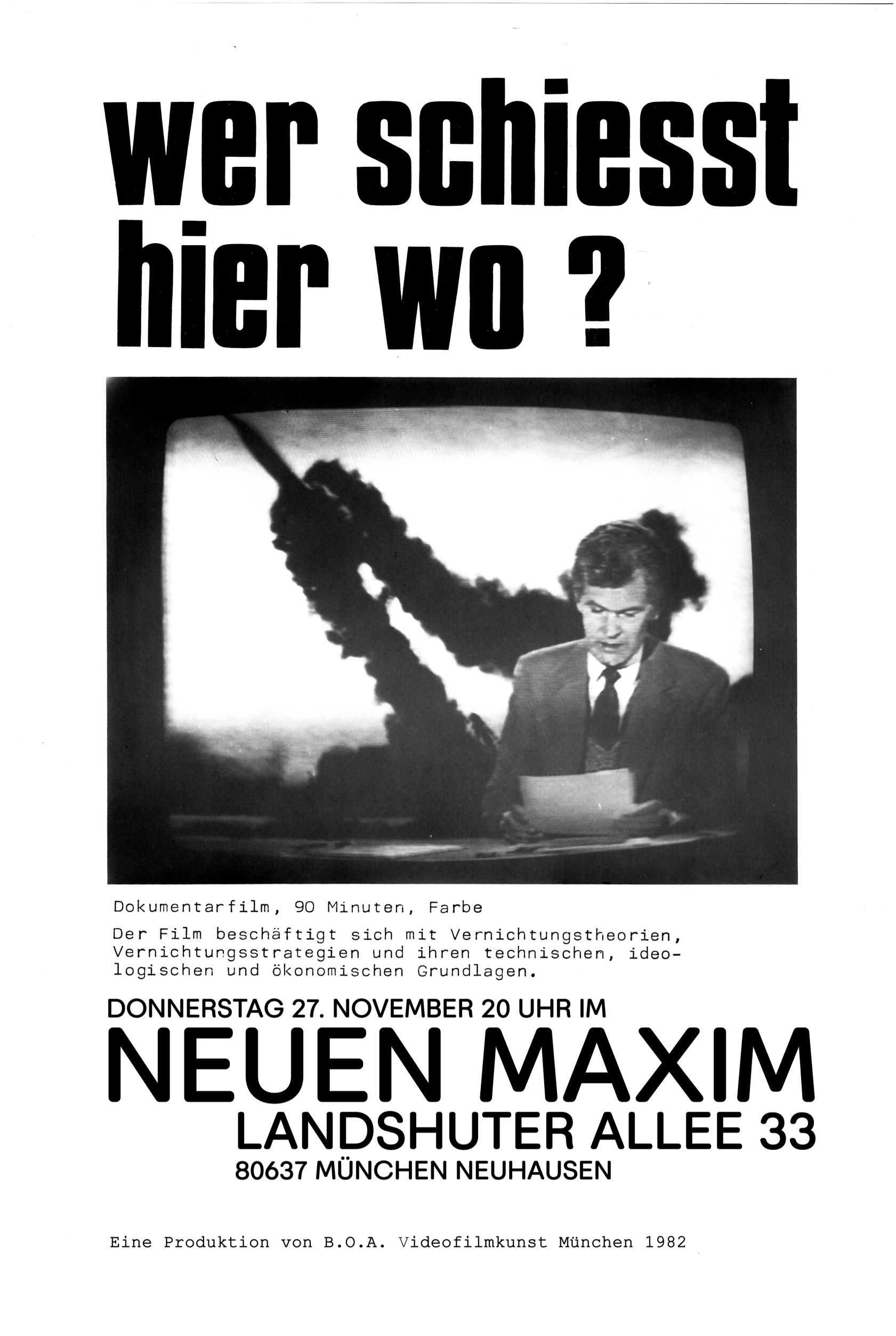
"Who is shooting where"
Survival - The video documentary
Süddeutsche Zeitung from Friday' July 23, 1982
Could an odel pit be converted into a fallout shelter? The expert on the phone
advises the caller to visit the
neighbor's cellar because of the potentially toxic gases. A mother, worried that her children
would be cut off from her at school in the event of a nuclear attack, is reassured by the expert who points out that
an emergency is always preceded by a period of preparation in the form of a crisis. Clearly
relieved, the woman hangs up the phone. These question and answer games about the atomic bomb
come from the BR radio program "Das Notizbuch" (The Notebook), and they seem no less absurd
than the excerpt from an American training film from the 1950s that demonstrates
survival at a picnic: The family throws dishes and food into the air
and crawls under the tablecloth.
Such scenes can be found in the documentary Who's Shooting Where by the video cooperative
B.O.A, which first of all makes it urgently clear that weapons technology has constantly evolved in the
almost forty years that we have been living with the bomb,
while the conversation about the protection of the civilian population has come to a standstill at the 1950
level. However, this insight does not result in the demand for more effective civil protection
: weapons of destruction can now be deployed so quickly, with such
precision and such destructive effect that protective measures would be pointless from the outset
. The only remedy against nuclear war is to prevent it. In view of the
"feasibility" of small, limited nuclear wars, as Robert Jungk puts it in this
documentary, the peace movement has become a survival movement.
To show how and why we are dependent on armaments, and what new dependencies
the further armament brings with it - that is the main focus of Who is shooting where.
The documentary works for the most part with material from German television; it
shows in a startling way how often images
are used to emphasize the aesthetics of modern weapons systems, even in critically intended contributions. But there are also
excerpts from programs that cannot be shown often enough: For example, the
interview with one of the fathers of the neutron bomb, who explains quite matter-of-factly that this
weapon was never intended for defense, but for attack from the very beginning. This is precisely
the special merit of the documentary: to bring together information that is publicly accessible but
otherwise too scattered and to gain new insights into
from it. Finally, the footage shot by video groups of the most recent
peace demonstrations in Munich, Bonn and Berlin illuminates the
dark spots in official reporting.
Who shoots where reflects the current state of the debate and establishes connections
that cannot be seen on television. The documentary is therefore also a
successful example of how groups that have little access to the media can create
publicity for themselves. (In Munich at the Werkstattkino, a cassette with the
documentary can be borrowed from the video cooperative B.O.A.).
CHRISTIAN BAUER, Süddeutsche Zeitung
With video against retrofitting:
"Who's shooting where?"
Taz of Wednesday, July 07, 1982
A tall order: to present the technical, ideological and
political foundations of nuclear rearmament in 90 minutes of documentary film. However, given the complexity of the topic, the filmmakers
have succeeded in neither confusing nor
oversimplifying.
Starting with a factual presentation of the significance of
cruise missiles, Pershing, the neutron weapon and the consequences of a nuclear attack,
the film moves on to the economic interests behind arms production and their
political implementation. At the latest in the last part, when footage of
peace demonstrations and street battles is shown, the filmmakers' political
interest becomes clear: they want to arouse commitment. This is a movie that doesn't
leave you frustrated, but makes you want to continue the discussion.
Production and distribution B.0.A. Video-Kooperative München
Rainer, taz-Munich
Who is shooting where?
Production: B. O. A. Videokooperative, Munich 1982, 90 min., color.
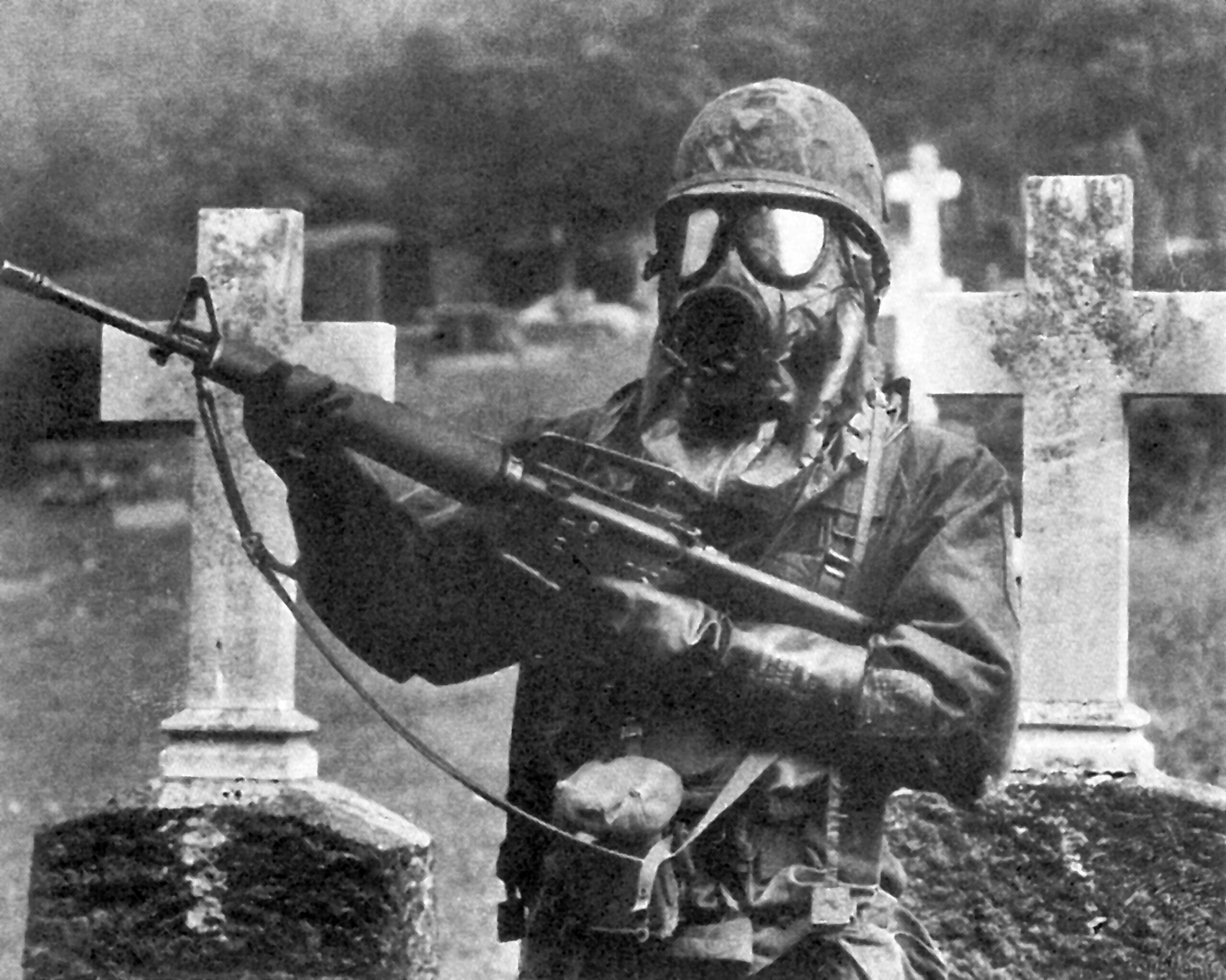
The video documents the history of weapons of mass destruction from the Second
World War to the Falklands War. It deals with theories of destruction,
destruction strategies and destruction systems. It shows the technical, economic
and ideological foundations of the production and use of these weapons.
Part 1: The survivors will envy the dead.
The death certificates for the third world war have already been printed, the weapons of destruction
have been thoroughly tested. The population is 'educated' in radio magazines about
self-protection measures in the event of a nuclear war: "The best thing to do is lie down
!" Experts discuss the question ''Does a septic tank protect?" It is shown how
so-called 'limited nuclear wars' are being prepared with the help of the new 'small and clean' nuclear weapons
such as cruise missiles. A war scenario with the consequences of the
neutron weapon and the Pershing missile is illustrated with footage
, some of which has not yet been shown.
Part 2: Advertising trips to hell
The US justification for 'rearmament' is based on the argument of the
missile gap. In contrast, the video shows how the 'national
security' business works, how politics and the information media are shaped by the interests and the
momentum of globally operating arms companies. Ernest Mandel reflects on the economic
background in a presentation on "Armaments production under
the conditions of permanent unemployment".
Part 3: There is only one protection against nuclear war: to prevent it.
The question of resistance against the threat of mass destruction is discussed on the basis of
peace initiatives, manifestations and non-violent actions.
This video - an impressive compilation of material from ARD and ZDF -
deals with the fragmented information for the television public. The
'second-hand experiences' offered by 'Tagesschau' and 'Heute' are brought back to
the concrete contexts of life and experience. The reconstruction
of a concealed and veiled reality is fascinating. The desires, fantasies and products of arms manufacturers
are portrayed in a breathtaking and
irritating way. In contrast, the current debate about the effects of medium-range missiles
appears to be a coffee-table conversation. While the peace initiatives
in this country are working on the next generation of US missile systems and
destruction potential, the next generation of weapons systems and the generation after that are already being planned, prototyped and financed in the research centers, at stock exchanges and
arms fairs
.
A video that is convincing in its clarity and provides sufficient
material for discussion. Who is shooting where? reflects the current state of affairs and
establishes connections that have never before been seen in Germany in such a sophisticated
radical form.
Review in the media handbook "Friedensarbeit" , Verlag Verein f. Friedenspädagogik Tübingen e.V. & Jugendfilmclub Köln e.V. 1983